The literature on the history of coffee from Africa to the wider world associates the discovery of coffee with Abyssinia, present-day Ethiopia, and recounts the well-known legend of Kalid, a goat herder who is traditionally said to have discovered the energizing effects of coffee berries around the ninth century AD. Other scholars emphasize the historical evidence of coffee consumption among Sufi communities in Yemen, where coffee became associated with religious practices and nighttime prayers.
02
Four questions, not one
These different perspectives demonstrate that the history of coffee involves several geographical locations, historical interpretations, and oral traditions. While some scholars emphasize Ethiopia as the natural home of Arabica coffee, others highlight Yemen's important role in the early documented consumption, preparation, and subsequent dissemination of coffee. Consequently, it is necessary to distinguish between the natural origin of the coffee plant, the discovery of its stimulating properties, the development of coffee as a prepared beverage, and its spread to other parts of the world.
03
Why look to Jimma
From my perspective, southwestern Ethiopia, particularly the Jimma area, deserves significant attention in discussions of the historical origin and early use of Arabica coffee. This argument is supported by the region's long-standing coffee-growing traditions, its natural forest environment, and the oral traditions associated with coffee. One of the best-known narratives is the legend of Kalid, the goat herder whose discovery of coffee is widely recounted in popular accounts of coffee history.
04 Oral tradition
The goatherd
According to this legend, Kalid lived in southwestern Ethiopia and herded goats in the surrounding highlands. Some versions of the story suggest that he came from Yemen for trading purposes before settling in the area, although this detail requires further historical verification. One day, he noticed that some of his goats behaved unusually after eating bright-red berries from a nearby coffee shrub. The animals appeared more energetic and active than usual, attracting his attention. Curious about their behavior, Kaldi decided to taste the berries himself and reportedly experienced a similar stimulating effect. Excited by this discovery, he collected some of the berries and took them home to share his experience with his wife.
05 Oral tradition
The monastery fire
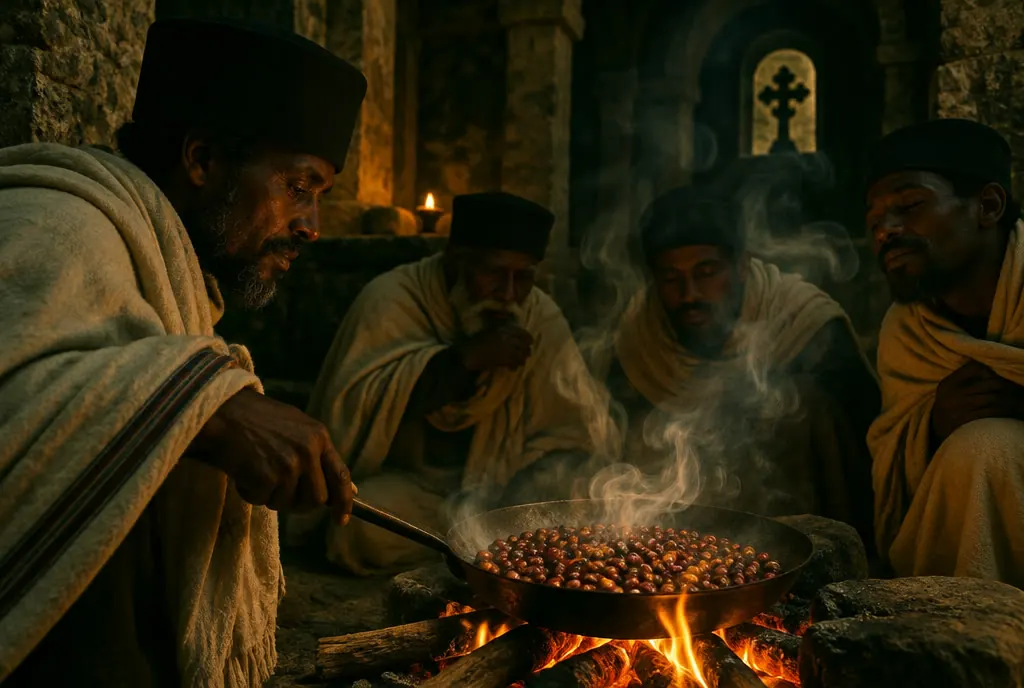
According to the popular version of the legend, Kaldi's wife interpreted the discovery as a gift from God and encouraged him to take the berries to a nearby monastery. Initially, the monks were skeptical of the berries' supposed miraculous properties. One monk reportedly considered them undesirable and threw them into a fire. As the berries roasted, however, they released an appealing aroma that attracted the attention of the other monks. They collected the roasted beans, placed them in hot water, and prepared a fragrant drink. After consuming the beverage, they reportedly experienced increased alertness and energy, which helped them remain awake during nighttime prayers. The story concludes that the monks continued drinking the beverage and that knowledge of coffee gradually spread to other communities.
06
A legend, not a record
Although the Kaldi narrative is one of the most popular stories associated with coffee's discovery, it should be treated as an oral or legendary account rather than a fully verified historical record. Its precise date, geographical setting, and individual details remain uncertain. Nevertheless, the story has become an important part of the cultural history of coffee and reflects the enduring association between Ethiopia and the coffee plant.
07
From Yemen to the world
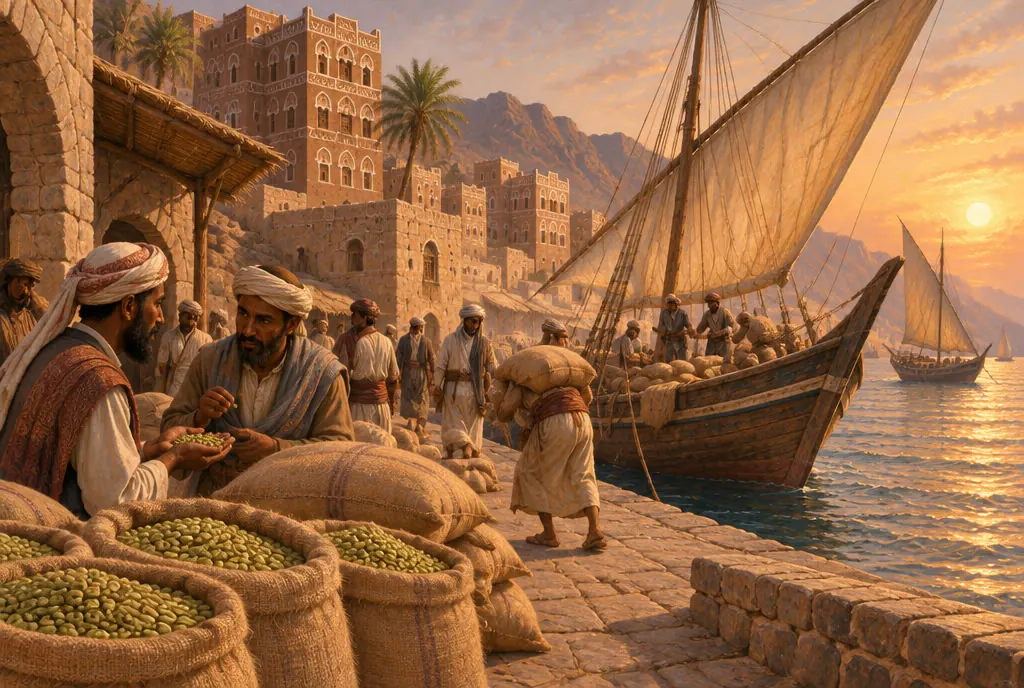
Historically, coffee subsequently became firmly established in Yemen, where its preparation and consumption developed, particularly among Sufi communities. From Yemen, coffee spread to other parts of the Arabian Peninsula and eventually reached Europe and other regions of the world through commercial, religious, and cultural networks. Therefore, Ethiopia's importance as a center of Arabica coffee's genetic diversity and natural growth should be distinguished from Yemen's documented role in the early development and international dissemination of coffee as a beverage.
08
Jimma and Ketta Muduga
In the context of southwestern Ethiopia, Jimma Zone occupies a particularly important place in discussions of coffee heritage. The region has a long-standing relationship with coffee cultivation, forest-based livelihoods, traditional exchange systems, and local cultural practices. The Ketta Muduga tradition is especially relevant to this discussion because it is associated with local understandings of coffee's history, production, and cultural significance. According to local beliefs and oral accounts, the Jimma area is regarded as one of the important places associated with the origin or early history of Arabica coffee.
09 Oral tradition
The goats' footprints
Local historical narratives also refer to features such as the alleged footprints of Kaldi's goats as evidence connecting the area with the coffee-discovery legend. Such features are important as elements of local memory, cultural identity, and heritage interpretation. However, their historical significance should be examined through systematic field observation, oral-history interviews, archival research, and, where possible, archaeological investigation. Until independently verified, the reported footprints should be described as a local tradition or belief rather than conclusive scientific evidence of coffee's place of origin.
10
What is still to learn
In conclusion, the history of coffee should be understood through a combination of botanical evidence, historical documentation, oral traditions, and cultural heritage. Ethiopia, particularly its southwestern forest regions, is widely recognized as the principal center of origin and genetic diversity of Arabica coffee. Within this broader context, Jimma Zone and its Ketta Muduga tradition deserve further historical investigation because they contribute to the understanding of coffee's cultural meaning and historical significance in Ethiopia. Further research into local oral traditions, historical records, coffee-growing landscapes, and associated heritage sites may help clarify the relationship between the region and the wider history of Arabica coffee. Such research would also contribute to the documentation, preservation, and promotion of Jimma's coffee heritage for future generations.